

Quick answer
PlayRez is our top pick for a small independent racquet club. Plus is $35 a month, month to month, and covers the whole week: unlimited courts and reservations, recurring open play and events with capacity limits and automatic waitlists, a member directory, and payments straight into your own Stripe account with no cut on club bookings. Tournaments come with it rather than as a second product: five formats up to 256 entrants, live scoring, public results, and the $1 per paid signup waived on a paid plan.
You can also run a tournament on PlayRez before paying anything at all. Hosting is free on the organiser side, with the same five formats and public results, and no platform fee when entry is free.
If you need point of sale, instructor payroll, or door hardware, look at PodPlay or RacquetDesk. If tournaments are the main business rather than something you run four times a year, look at Pickleball Den. If you want free club management specifically, Global Pickleball Network is the better starting point.
PlayRez publishes this comparison. We applied the same documented criteria to every product, linked volatile facts to official sources, and separated what we tested from what we could only read.
PlayRez Tip
Our top pick for small independent racquet clubs. Run tournaments free with no subscription, or $35 a month for the full club side with the $1 per-paid-signup fee waived.
How we chose these platforms
Most comparisons ask whether a product lists court booking, members, and tournaments. All eight of these do, so that question sorts nothing.
The question that separates them is what happens to your players, courts, payments, and schedule on the day ordinary club operations turn into a tournament. Everything below is organised around three things: how each platform runs the day to day, how it runs an event, and what carries over between the two.
To qualify, a platform had to manage ordinary club operations as well as tournaments. Tournament-only tools were excluded. CourtReserve was excluded because its current Swish documentation says tournament formats are not supported. Waresport was excluded until its pricing, contract, fees, and tournament inclusion can be confirmed in writing.
- Daily club operations: courts, reservations, members, open play, recurring events
- Tournament execution: formats, pools, brackets, court assignment, live scoring, public results
- The handoff: what carries from the club into a tournament, and what comes back
- Player and spectator experience, including whether anyone has to download an app
- Published price, fees, add-ons, and contract length, with quote-required marked as such
- Setup burden measured in screens and decisions rather than marketing claims
- Reporting, exports, and the DUPR path
- We publish no scores. Only PlayRez could be tested hands on, and a weighted number out of 100 would reward that access while looking objective. Ranking by fit and showing the evidence behind each claim is the honest version of the same job.
Native, same vendor, or integration
Three phrases describe three genuinely different products, and vendors use all three interchangeably.
A native system runs club and tournament functions inside one product, with no second system to transfer participants into. An official integration stack means the club platform hands your participants to another product, usually Swish, and takes them back afterwards. Native does not mean every record is shared, and it is worth keeping those two ideas apart: PlayRez is native and still does not carry club members into tournament registration.
All three can work. The difference does not appear in a feature list, and it does not appear during a demo. It appears on a Saturday morning when someone withdraws and you find out how many places you have to go to fix it.
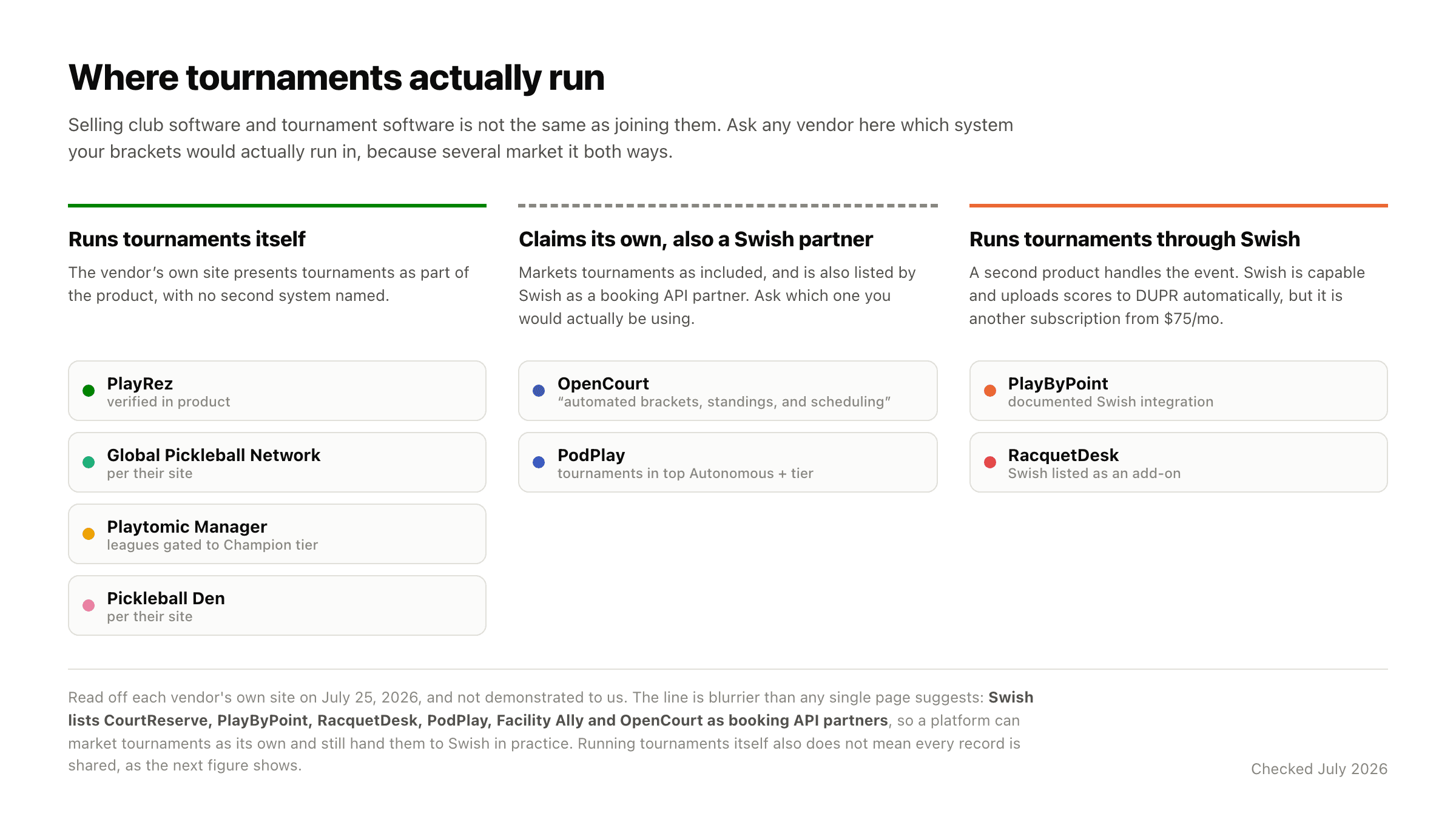
- Native, verified in product: PlayRez
- Native by their own description: Global Pickleball Network and Playtomic Manager, though Playtomic gates leagues to its Champion tier and PodPlay gates tournaments to its top Autonomous + tier
- Runs tournaments through Swish: PlayByPoint and RacquetDesk, both of which Swish lists as API partners
- Claims native but also partners with Swish: OpenCourt and PodPlay. Swish lists CourtReserve, PlayByPoint, RacquetDesk, PodPlay, Facility Ally and OpenCourt as court-booking API partners, so the line between native and integrated is blurrier than any single marketing page suggests.
The eight at a glance
Prices below were checked on the dates given. Where a vendor does not publish a number, this says so rather than guessing, and quote-required is never counted as included.
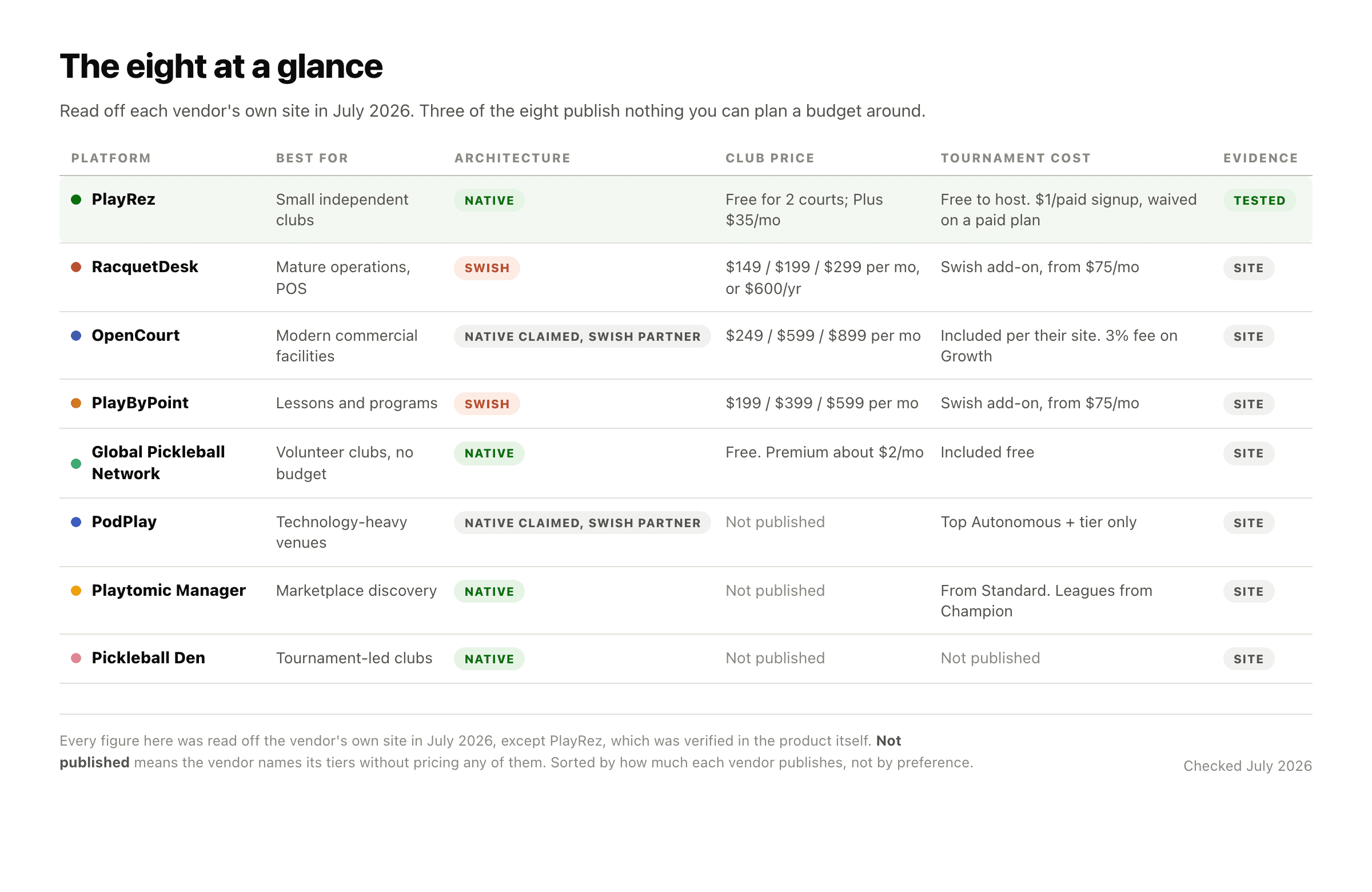
- PlayRez. Best value for small independent racquet clubs, and the best free option for tournaments. Native. Free for 2 courts and 100 monthly reservations, Plus $35 a month, month to month. Tournaments free to host, $1 per paid signup waived on a paid plan. Tested hands on July 25, 2026.
- PodPlay. Best full-stack option for technology-heavy venues. Four tiers (Basic, Basic Plus, Pro, Autonomous +) with no published prices. Tournaments and leagues appear only in the top Autonomous + tier. Checked July 25, 2026.
- Pickleball Den. Best pickleball-specific tournament depth. Runs tournaments itself. No pricing published for Club Suite or the per-player tournament fee. Checked July 25, 2026.
- Global Pickleball Network. Best free club management. Ladder leagues, tournaments and events are free; premium is stated as around $2 a month. Formats include single and double elimination, first round consolation, compass, and round robin. Checked July 25, 2026.
- Playtomic Manager. Best marketplace and social-play option. Four tiers (Standard, Professional, Champion, Master) with no published figures. Tournaments appear from Standard; leagues only from Champion. Checked July 25, 2026.
- OpenCourt. Best modern commercial facility experience. Growth $249/mo or $199 annually, Pro $599/$499, Elite $899/$749, Enterprise custom. Growth carries a 3% service fee. Its own site claims automated brackets; it is also a Swish API partner. Checked July 25, 2026.
- PlayByPoint. Best for lessons and programs. Official Swish integration. Essential $199, Advanced $399, Premium $599 a month, each marked with an asterisk. Tournaments run through Swish, from $75/mo. Checked July 26, 2026.
- RacquetDesk. Best for mature operations, POS, and billing. Official Swish integration. Lite $149/mo, Standard $199/mo, Pro $299/mo, or Seasonal $600/yr. Tournaments run through a Swish add-on. Checked on racquetdesk.com, July 25, 2026.
Our top pick
PlayRez: best value for small independent racquet clubs
PlayRez is built for a club with two to eight courts, a volunteer organiser or lean staff, regular open play, and a handful of structured tournaments a year. It is not built for a facility with a pro shop and a payroll.
On the club side it handles the day to day: court reservations with flexible lengths, recurring open play and events with capacity limits and automatic waitlists, and online payments that go straight to your Stripe account with no PlayRez fee on club bookings.
On the tournament side it supports round robin, single elimination, double elimination, group plus knockout, and Swiss, up to 256 entrants, with live scoring and public results. Entry fees run through the club Stripe account rather than an organiser personal account.
Setup is a ten-step wizard, which sounds worse than it is. Walking it end to end, the defaults carry through, so a straightforward tournament can be built by accepting them and clicking on. The step count reflects how many choices exist, not how many you have to make.
The handoff is where it is worth being specific. Courts, the booking calendar, the Stripe account, and admin access are shared, and tournament matches become real bookings on your courts so nobody books a court out from under an event in progress. Player records are not shared. A club member registering for your tournament types their details in again, and membership tiers do not affect entry pricing. If your tournaments are mostly your own members, that is an hour of typing you would rather not do.
- Architecture
- native. Tournaments run inside PlayRez with no second system. Courts, calendar, payments and admin access carry across; member records and membership pricing do not.
- Club strengths
- unlimited courts and reservations on Plus, recurring events, automatic waitlists, browser booking with no player app
- Tournament strengths
- five formats up to 256 entrants, live scoring, public results, entry fees to the club account
- Pricing
- Free for 2 courts and 100 monthly reservations. Plus $35 a month, month to month, cancel anytime. Tournaments free to host. The $1 per paid signup is waived while the club holds a paid subscription.
- Main limitation
- club members are not carried into tournament registration, and there is no direct DUPR integration. Ratings are collected and exported, not synced back.
- Evidence status
- tested hands on, July 25, 2026
Tip
Ask us the same thing you should ask everyone else here: show me a club member registering for a tournament without re-entering their details. Right now we cannot, and we would rather you hear that from us than find it on a Saturday.
See the club side in more detail on pickleball club management software , or open the live demo and build a tournament yourself before deciding.
Alternative 02
PodPlay: best full-stack option for technology-heavy venues
PodPlay runs club operations and tournaments in one native system, which puts it in a different category from the platforms here that hand tournaments to Swish. It is aimed at venues built around technology: automated access, monitored courts, and operations that run with very little staff on site.
The complication is that the price is not one number. There is a subscription tier, a separate venue fee, and hardware with installation on top, and tournaments appear to sit behind a higher tier. A four-court club needs all four figures before comparing PodPlay against a flat monthly price.
Two questions are worth putting directly to them. Whether tournament DUPR reporting depends on their Pro Monitors, and whether a waitlist promotes one named player or notifies everyone at once. The second sounds trivial and decides whether your open play sessions run themselves or generate a queue of messages to you.
- Architecture
- native
- Club strengths
- built for autonomous, low-staff operation with court technology from the same vendor
- Tournament strengths
- tournaments and leagues are listed only under the top Autonomous + tier, so the entry tiers do not appear to include them
- Pricing
- not published. Four tiers are listed (Basic, Basic Plus, Pro, Autonomous +) with no figures against any of them. Hardware such as scoreboards and video replay is described as optional.
- Main limitation
- total cost is assembled from several figures, and tournaments may require a higher tier
- Evidence status
- read off the vendor’s own site, July 25, 2026. Not tested.
- Verify before comparing
- the four-court price by tier, the separate venue fee, hardware and installation costs, which tier includes tournaments, whether DUPR reporting needs Pro Monitors, and how waitlist promotion behaves.
Alternative 03
Pickleball Den: best pickleball-specific tournament depth
Pickleball Den is pickleball-first rather than a racquet-sports platform with pickleball support, and its tournament side is built with more depth than most of this list. If tournaments are what your club is for, it belongs on your shortlist.
It is a native system, so club and tournament functions live in the same product. What needs confirming is how much actually travels between them: whether club members and courts carry into the Tournament Suite, and whether membership status or discounts reach tournament registration. Those are the same two questions PlayRez currently answers with a no, and a native architecture does not automatically answer them with a yes.
On price, the per-player tournament technology fee is the figure that scales with you. At 128 registrations a year it can outweigh the subscription difference between most platforms here, so get the exact number rather than a range.
- Architecture
- native
- Club strengths
- Club Suite covers ordinary club operations alongside the tournament product
- Tournament strengths
- the deepest pickleball-specific tournament tooling on this list
- Pricing
- not published. Club Suite subscription plus a per-player tournament technology fee plus processing fees.
- Main limitation
- the per-player fee scales with your registration volume rather than staying flat
- Evidence status
- read off the vendor’s own site, July 25, 2026. Not tested.
- Verify before comparing
- the Club Suite price, the exact per-player technology fee, processing fees, whether club members and courts carry into the Tournament Suite, and whether membership discounts apply to tournament registration.
If you only need a draw rather than a platform, our free pickleball bracket generator builds single and double elimination draws with no account.
Alternative 04
Global Pickleball Network: best free club management
Global Pickleball Network is a community network with club and tournament tools attached rather than club software with a social layer. For a volunteer-run group with no budget, that distinction matters less than the price. Free software that actually gets set up beats paid software that nobody configures.
What needs confirming is where the free tier stops. Specifically: which features require premium, what the payment platform takes when you collect entry fees, whether pool play can feed a playoff bracket, and whether rosters and courts are reused between events or re-entered each time.
Export matters more here than anywhere else on this list. If the club outgrows it, you want the member list and the results to come with you, and that is a question to ask on the way in rather than on the way out.
- Architecture
- native community network
- Club strengths
- a genuinely free starting point with community reach for finding players
- Tournament strengths
- tournament tools included at no subscription cost
- Pricing
- the site says you can create a ladder league, a tournament, or events completely free, and puts premium membership at around $2 a month. No exact figure or payment-processing fee is published.
- Main limitation
- the boundary between free and premium needs confirming before you plan around it
- Evidence status
- read off the vendor’s own site, July 25, 2026. Not tested.
- Verify before comparing
- which features require premium, what payment platform fees apply, how pool play feeds a bracket, whether rosters and courts are reused between events, and what export options exist.
Alternative 05
Playtomic Manager: best marketplace and social-play option
Playtomic real asset is the marketplace. If there are already Playtomic players in your area, being listed is a source of court revenue that none of the other platforms here can offer, and for some clubs that outweighs the software comparison entirely.
The tournament side needs the closest look of anything on this list. It is native, but format support appears limited, and this is the platform most likely to be missing something you assume is standard. Confirm specifically whether classic single elimination exists, whether double elimination exists, and whether pool play can feed a bracket.
Also check what players and spectators can see without relying on a chat thread. A tournament where the standings live in a group message is a tournament you are personally answering questions about all day.
- Architecture
- native, but format-limited
- Club strengths
- marketplace discovery from players who are not members yet, and a strong social play model
- Tournament strengths
- integrated with the same booking and player base, subject to format limits
- Pricing
- not published. Four tiers are named (Standard, Professional, Champion, Master) with feature comparisons but no numbers.
- Main limitation
- tournament formats may not cover classic elimination brackets
- Evidence status
- read off the vendor’s own site, July 25, 2026. Not tested.
- Verify before comparing
- the subscription price and contract, whether classic single elimination and double elimination exist, whether pool play can feed a bracket, what players and spectators see without chat, and how DUPR is handled.
For recurring social play rather than brackets, the free pickleball round robin generator produces the rotation without a subscription.
Alternative 06
OpenCourt: best modern commercial facility experience
OpenCourt covers a wide commercial footprint at its entry tier: unlimited courts and members, real-time booking, waitlists, events, lessons, memberships, point of sale, waivers, community groups, door access, and video replay integrations. For a staffed commercial venue that is a lot of product for the money.
The tournament story is unresolved, and it is the thing to settle before signing anything. The main site advertises automated brackets and tournament scheduling. The help centre tells clubs to transfer participants into Swish. Those describe two different products, and only one of them is a single system.
Ask OpenCourt to demonstrate a complete tournament, pools through to a playoff bracket, without touching Swish. If they can, it belongs in the native group. If they cannot, it is an integration stack and should be priced as two products.
- Architecture
- unresolved. Native brackets advertised, help centre directs to Swish.
- Club strengths
- broad commercial operations at the entry tier, unlimited courts and members
- Tournament strengths
- depends entirely on whether native brackets exist
- Pricing
- Growth $249/mo or $199 billed annually, Pro $599/$499, Elite $899/$749, Enterprise custom. Only Growth carries the 3% per-transaction service fee; the higher tiers show 0%.
- Main limitation
- the architecture question is unanswered, and it changes both the workflow and the price
- Evidence status
- read off the vendor’s own site, July 25, 2026. Not tested.
- Verify before comparing
- whether a complete native tournament runs without Swish, and the total of subscription plus the 3% Growth service fee plus payment processing plus any Swish cost at your real registration volume.
Alternative 07
PlayByPoint: best for lessons and programs
PlayByPoint is strong where the money is in coaching. Lessons, programs, staff operations, and payments are the core of it, and the Essential tier already includes reservations, programs, lesson bookings, a mobile app, and integrated payments.
Tournaments come through Swish rather than natively. That is an official, supported integration rather than a workaround, but it is two products with two subscriptions, and the questions that matter are about the seam. Whether participant changes and refunds sync both ways, and whether Swish court assignments update PlayByPoint court inventory. If they do not, a same-day schedule change is a job you do twice.
The commitment is the other consideration. Published prices are based on an annual contract, so you are committing for a year before you find out how the tournament handoff feels in practice.
- Architecture
- official integration with Swish
- Club strengths
- deep lesson and program operations, mobile app and integrated payments at the entry tier
- Tournament strengths
- delivered through Swish, which is capable but separate
- Pricing
- Essential $199/mo, Advanced $399/mo, Premium $599/mo, each shown with an asterisk on the pricing page. An earlier check recorded those rates as requiring an annual contract. Tournaments need Swish on top, from $75/mo.
- Main limitation
- annual contract, and tournaments require a second product and a second subscription
- Evidence status
- read off the vendor’s own site, July 25, 2026. Not tested.
- Verify before comparing
- which PlayByPoint tier and which Swish tier you need, partner pricing for both, whether participant changes and refunds sync both ways, and whether Swish court assignments update PlayByPoint inventory.
Alternative 08
RacquetDesk: best for mature operations, POS, and billing
RacquetDesk is aimed at operations that have outgrown simple booking software. Point of sale, membership billing, and the administrative depth a facility with several departments actually needs.
Tournaments run through Swish, so the same integration questions apply as with PlayByPoint. The ones specific to RacquetDesk are which player and payment fields transfer across, and whether results and DUPR status come back afterwards. A tournament whose results never return to the system holding your member records leaves you reconciling by hand.
This is the most operationally complex option here, and for the right facility that complexity is the point. For a two-to-eight court club it is a back office you will not staff.
- Architecture
- official integration with Swish
- Club strengths
- genuine point of sale and membership billing, built for multi-department operations
- Tournament strengths
- delivered through Swish
- Pricing
- Lite $149/mo, Standard $199/mo, Pro $299/mo, or Seasonal $600/yr, all with unlimited members, employees, and courts. Tournaments need Swish on top, from $75/mo. The integration fee is not stated publicly; the site says to call.
- Main limitation
- three costs to assemble, and results may not return to the club system
- Evidence status
- read off the vendor’s own site, July 25, 2026. Not tested.
- Verify before comparing
- the required RacquetDesk tier, the Swish integration fee, the required Swish tier, which player and payment fields transfer, and whether results and DUPR status return to RacquetDesk.
What testing showed
Only PlayRez could be tested hands on, so these findings are about PlayRez. They are published because they are the kind of thing no vendor writes on its own pricing page, including us.
Tournament matches become real bookings on the club courts. That means the booking calendar cannot sell a court that a tournament is using, which is the single most common way a club double-books itself on event day. It is worth asking every other vendor on this list to demonstrate the same thing.
Club members are not reused. A member already in the directory registers for a tournament as a new entrant and types their details again. Membership tiers and discounts do not reach entry pricing either. For a club whose tournaments are mostly its own members, that is the largest single piece of avoidable work in the whole workflow.
Courts are copied in at creation rather than linked. Rename a court after building a tournament and the tournament keeps the old name. Minor, but it surprises people.
Setup took ten screens and no typing. Walking the wizard end to end with defaults produced a valid tournament. Step counts are a poor measure of setup burden, and we would rather publish the number and explain it than let a competitor publish it without the explanation.
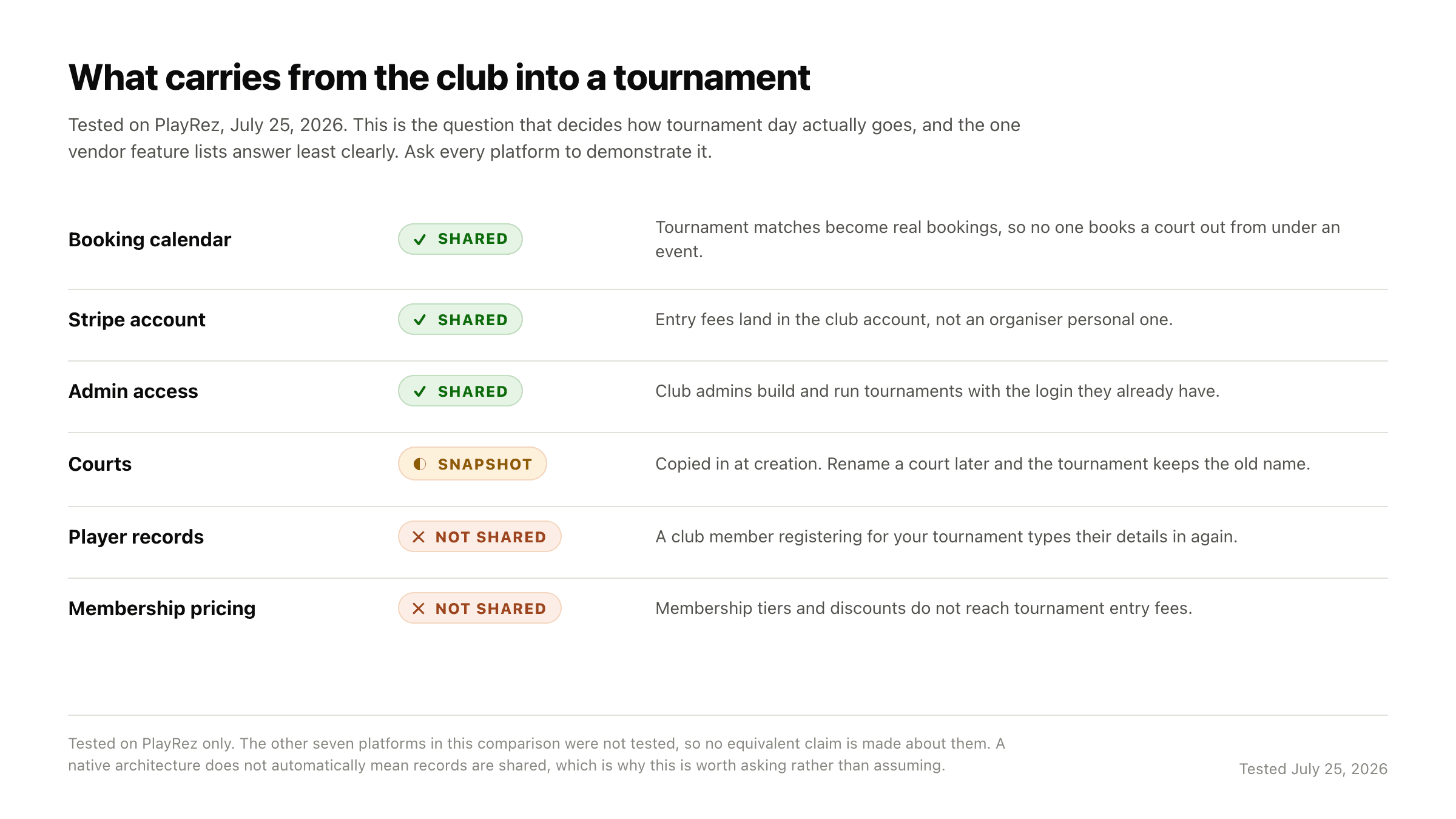
- Courts reused: yes, as a snapshot taken when the tournament is created
- Players reused: no. Club members re-enter their details to register.
- Booking conflicts blocked: yes. Tournament matches hold the real court calendar.
- Payments shared: yes. Entry fees go to the club Stripe account, not an organiser personal account.
- Another app required: no. Players book and register in a browser.
- Public live results: yes, with live scoring during play
- DUPR: collected and exported, not synced back
The booking side of that is covered in recurring open play and events , which is where capacity limits and automatic waitlists live.
The free option most clubs miss
You can run a real tournament on PlayRez without paying anything. Single elimination, double elimination, round robin, group plus knockout, and Swiss, with live scoring and public results, at no subscription cost and no per-player fee when entry is free. Up to five can be active at once.
That is worth stating plainly because most of this industry does not do it. Tournament software is usually where the per-player fee lives, so free formats with public results is not the normal shape of a free tier.
The caveat is real and you should know it before you start. Free tournament hosting runs on its own, as an organiser. Attaching a tournament to your club, so it shares the club courts, the booking calendar, and the club Stripe account, requires Plus at $35 a month. A free-plan club that tries to create a tournament from the club side is told to upgrade.
So the honest framing is this. If you organise tournaments, PlayRez costs nothing and always has. If you want those tournaments wired into the rest of your club, that is the $35 plan.
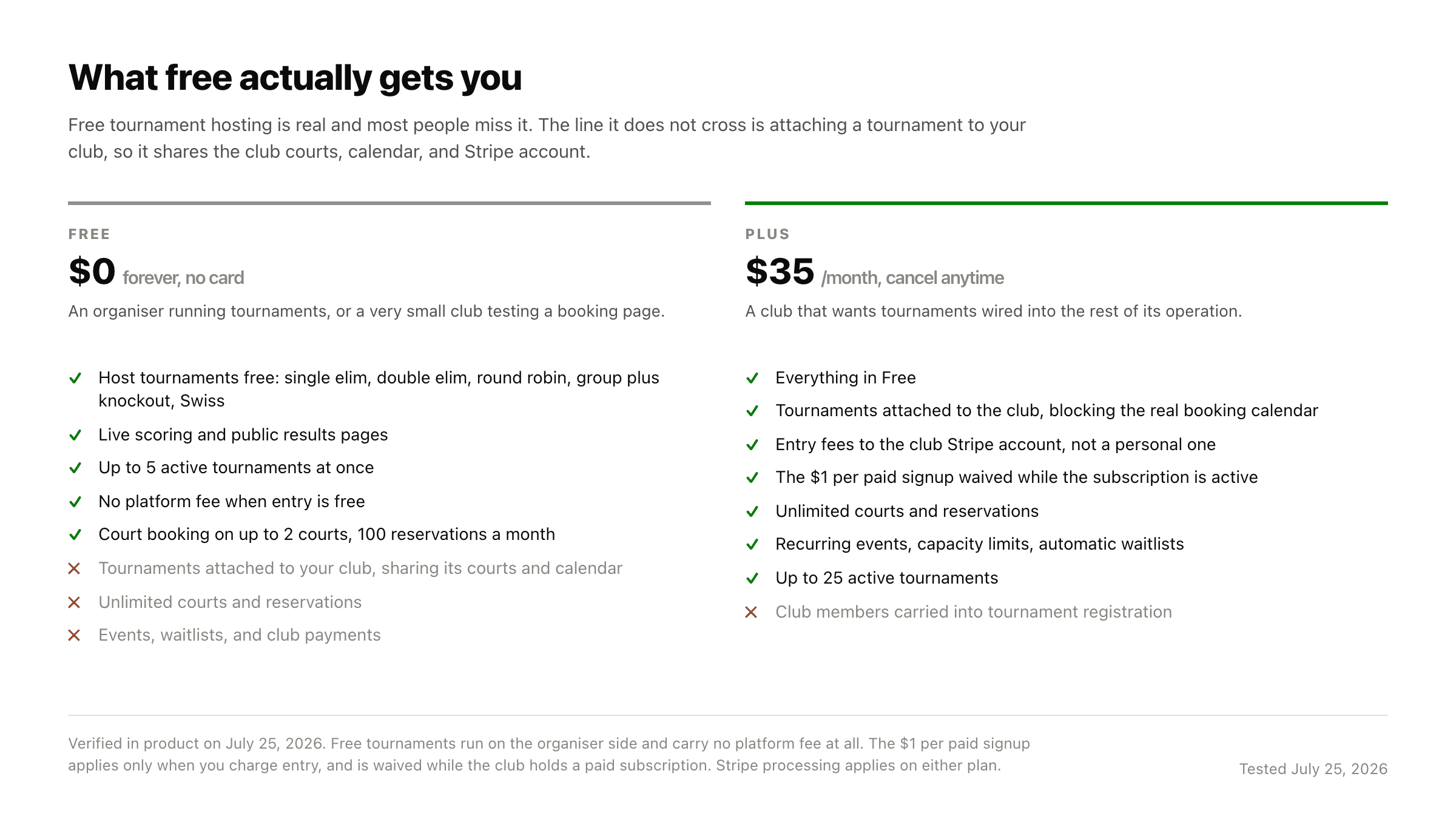
- Free, no subscription: all five formats, live scoring, public results, up to five active tournaments
- Free entry means no platform fee at all. The $1 per paid signup only applies when you charge.
- Requires Plus: attaching a tournament to your club so it shares courts, calendar, and the club Stripe account
- Global Pickleball Network remains the better free option if what you need is free club management rather than free tournaments
Tip
If you are running one tournament to see whether software helps, start on the free organiser side. There is nothing to cancel and no card to enter, and you will learn more in one event than in any demo.
All of this runs on PlayRez tournament hosting , which is the same system a Plus club uses once it wants tournaments wired into its courts and calendar.
Who lets you try it without asking
This industry is mostly not self-serve, and for the club this article is written for, that is a bigger obstacle than any feature gap.
A volunteer organiser running a four-court club is not going to book a scheduled sales call to discover whether software costs $50 or $250 a month. If a vendor will not tell them the price without a meeting, most of them stop there. That is not a criticism of demo-led selling, which works fine for a staffed commercial facility with a procurement process. It is a mismatch with the buyer.
Five of the eight publish enough to budget against. PlayRez lets you sign up, build a club, and create a tournament without speaking to anyone, and the free plan needs no card. RacquetDesk prices all four of its tiers openly. OpenCourt publishes four tiers with monthly and annual rates and states its 3% Growth service fee rather than hiding it. Global Pickleball Network is free to start and puts premium at about $2 a month.
Three name their tiers and price none of them. PodPlay lists Basic, Basic Plus, Pro and Autonomous +, Playtomic lists Standard, Professional, Champion and Master, and Pickleball Den publishes no figures at all. In each case you can see exactly what you would be buying and nothing about what it costs, which makes a like-for-like comparison impossible without a sales conversation.
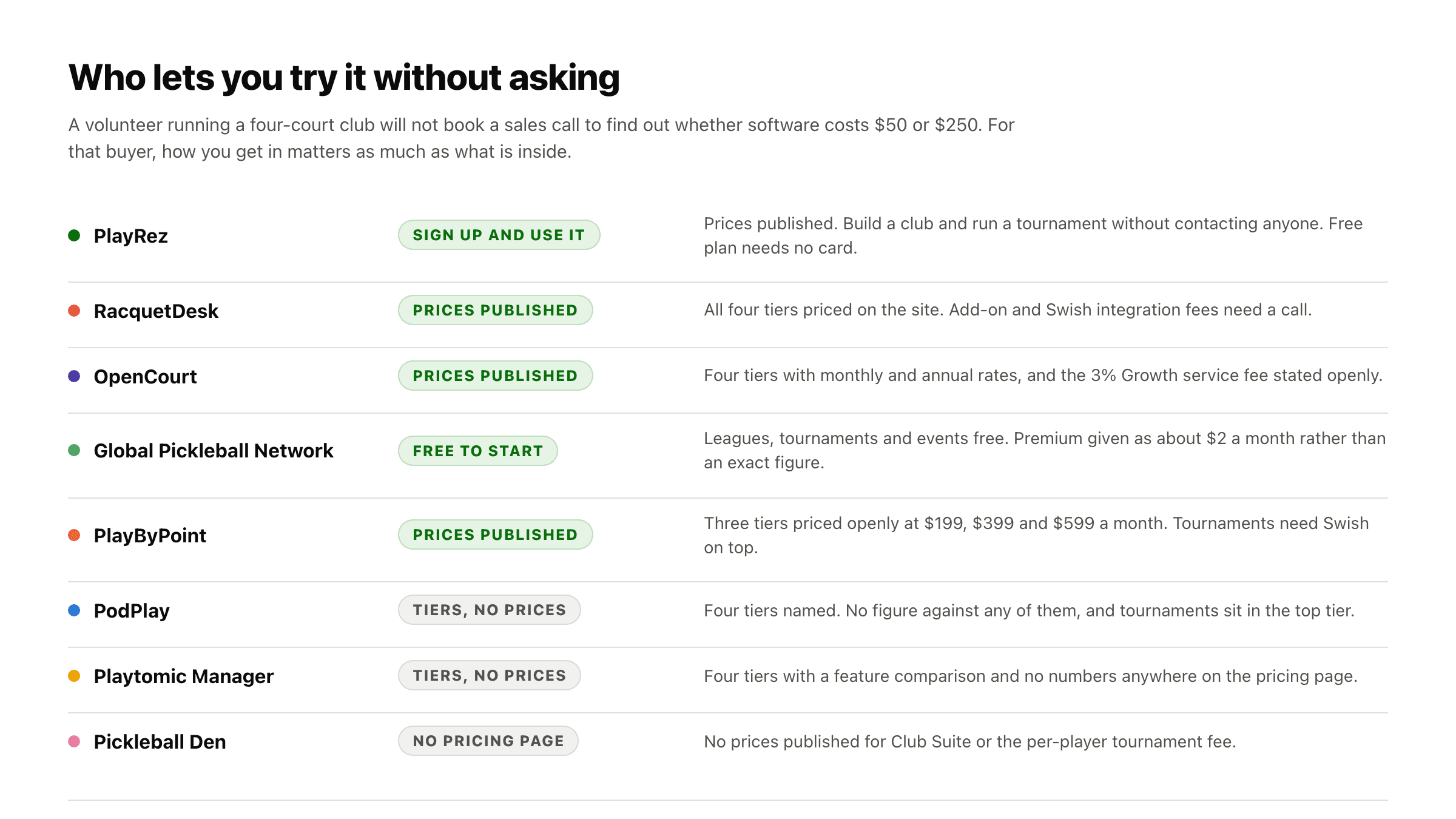
- Sign up and use it without contacting anyone: PlayRez
- Free to start, premium stated as roughly $2 a month: Global Pickleball Network
- Tiers named, no prices attached: PodPlay, Playtomic Manager, Pickleball Den
- Full pricing published on the site: PlayByPoint, RacquetDesk, OpenCourt
Tip
If you only do one thing before choosing, do the job in the software rather than watching someone else do it. Build a tournament, register a player, withdraw them, and change a court time. Any vendor unwilling to let you try that unaccompanied is telling you something.
What a year actually costs
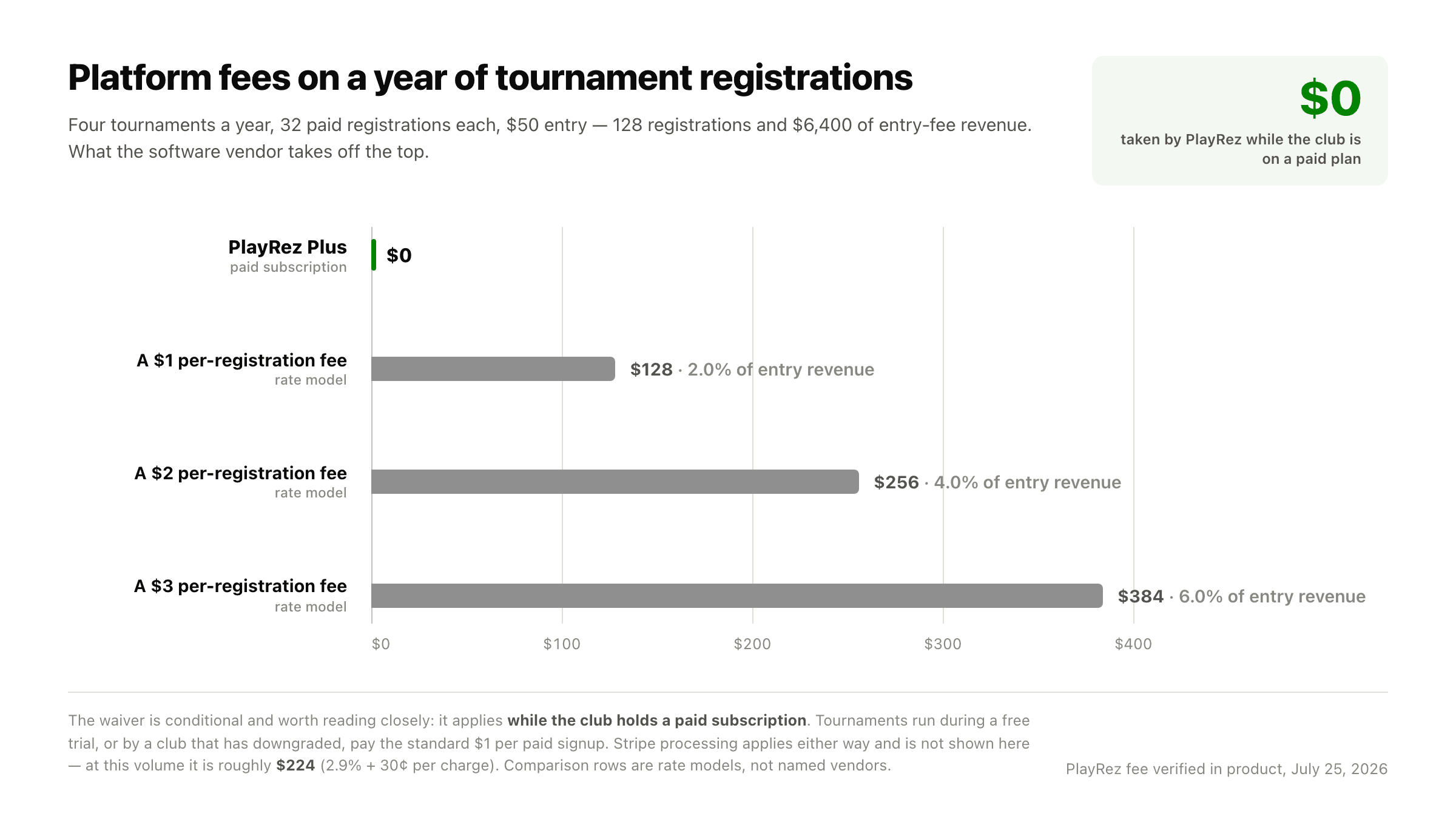
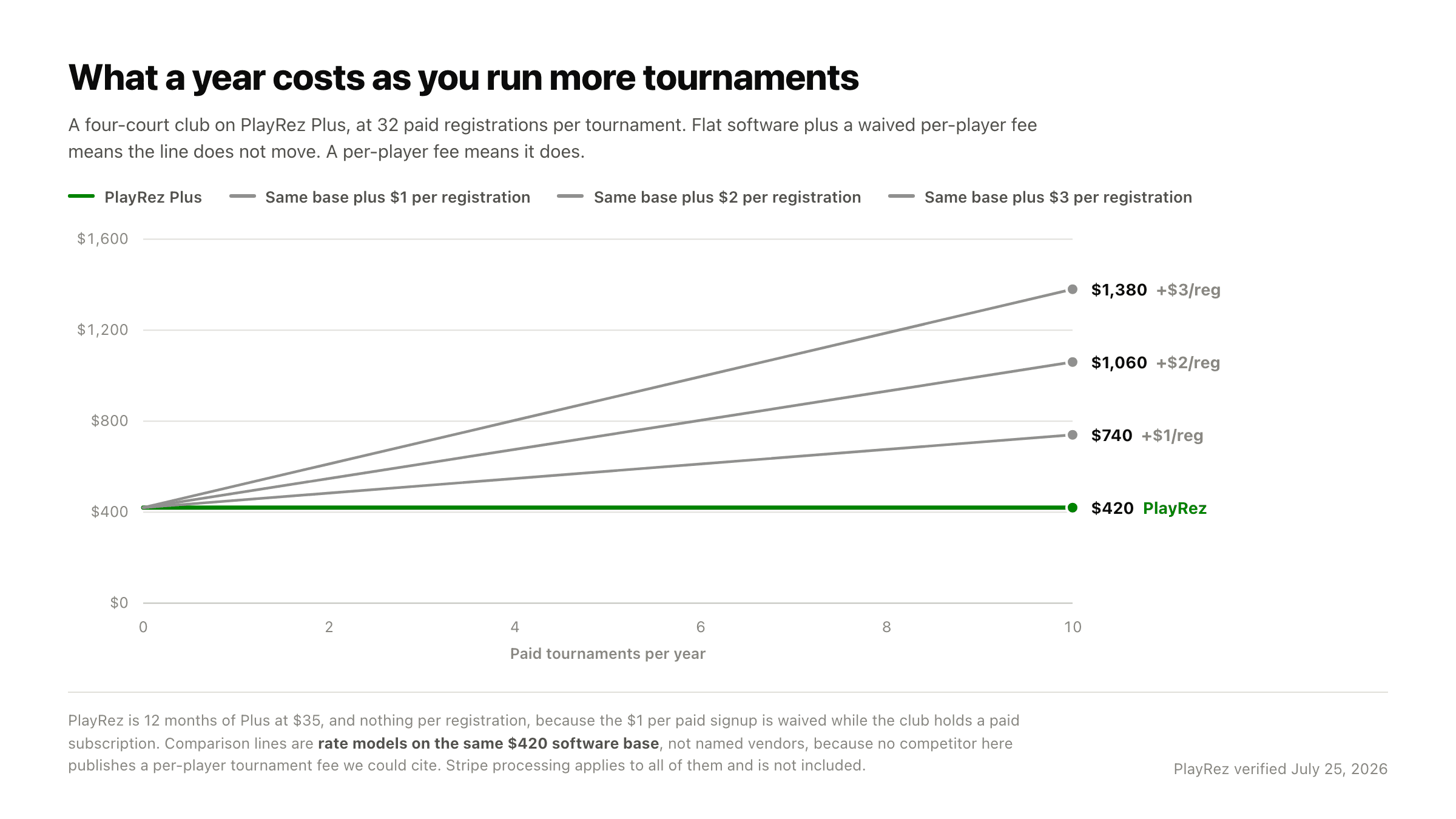
Compare on one scenario rather than on list prices. Ours is a four-court club with 150 members running four paid tournaments a year at 32 paid registrations each. That is 128 registrations and $6,400 of entry-fee revenue.
On PlayRez that year costs $420. Twelve months of Plus at $35, and nothing on the tournament side, because the $1 per paid signup is waived while the club holds a paid subscription. Stripe processing is separate and applies on any platform, roughly $224 at this volume.
The waiver is conditional and worth stating plainly rather than burying. Tournaments run during a free trial, or by a club that has since downgraded, pay the standard $1. We would rather you know that now than discover it in a payout.
The figure that catches people out elsewhere is the per-player fee, because it scales with success. At 128 registrations, a dollar a head is $128 and three dollars a head is $384, which is most of a year of club software on the cheaper end of this list. When you collect quotes, get the per-player number separately from the subscription and multiply it by your own registration count.
- Club subscription, quoted per month and per year
- Tournament subscription or add-on, if it is separate
- Per-player or per-registration fee, multiplied by your real annual volume
- Vendor transaction fee, which is separate from card processing
- Card processing, which applies everywhere
- Setup, implementation, and any hardware
- Minimum contract value, which is the number that actually commits you
- Never treat quote-required pricing as zero or as included. Three of the eight name their tiers without pricing any of them, and an unknown is not a discount.
Entry fees and club bookings both run through online booking and event payments , which pays out to your own Stripe account.
How to choose by club type
The right answer depends less on the software than on which of these you are.
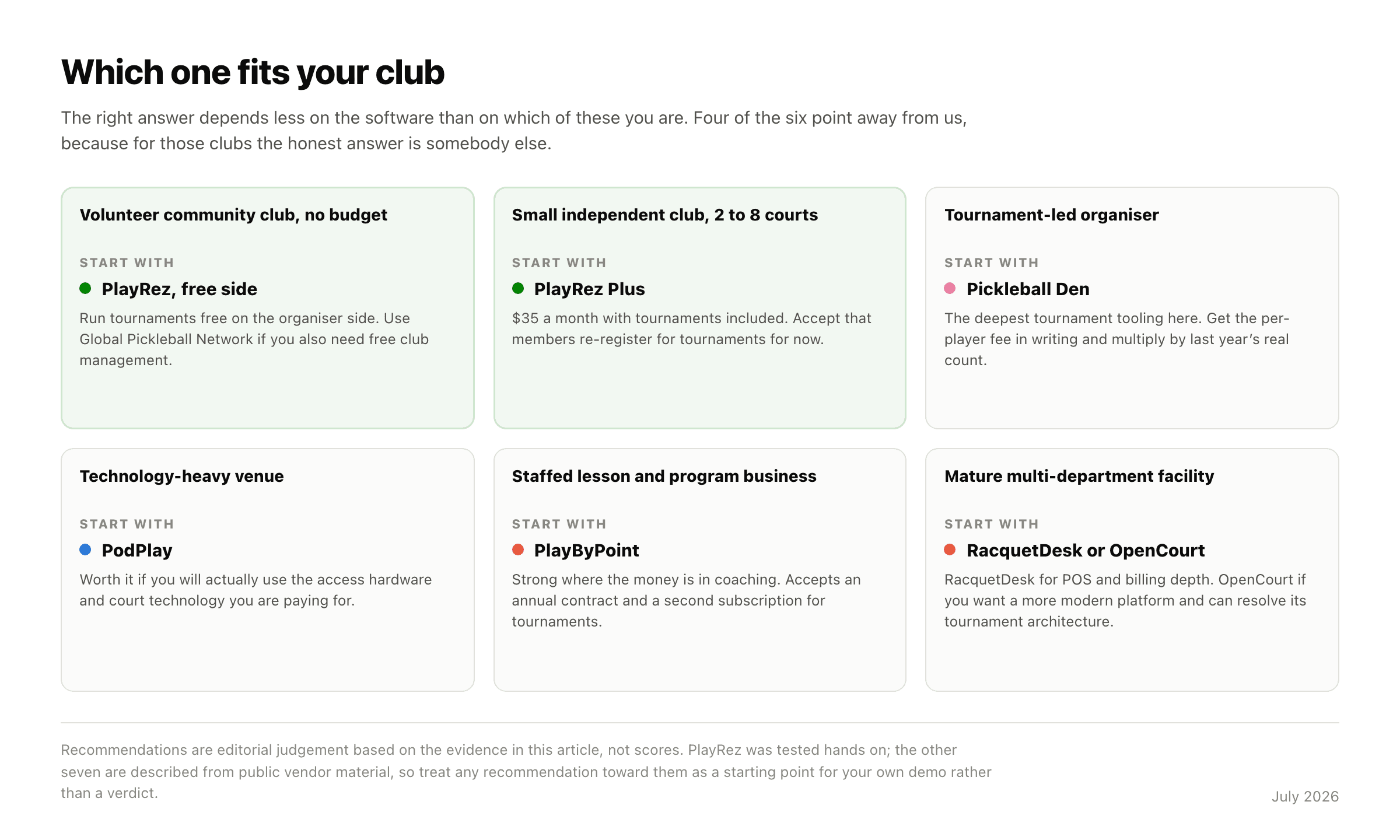
- Volunteer community club with no budget: run your tournaments free on PlayRez, and use Global Pickleball Network for free club management. Check the export path early so outgrowing either is not expensive.
- Small independent facility, two to eight courts: PlayRez, at $35 a month with tournaments included. Accept that members re-register for tournaments for now.
- Tournament-heavy organiser: Pickleball Den for the depth. Get the per-player fee in writing and multiply it by last year real registration count.
- Technology-heavy venue: PodPlay, if you will actually use the hardware and access technology you are paying for.
- Staffed lesson and program business: PlayByPoint, accepting an annual contract and a second subscription for tournaments.
- Mature multi-department facility: RacquetDesk for the point of sale and billing depth, or OpenCourt if you want a more modern platform and can resolve its tournament architecture.
If you are switching from CourtReserve specifically, we have a separate comparison of CourtReserve alternatives with pricing checked against each vendor official page.
Methodology and sources
PlayRez was tested hands on on July 25, 2026. We created a club with four courts, walked the tournament setup end to end, and confirmed the platform fee behaviour in the product itself. Findings from that test are labelled as tested throughout.
The other seven were not tested. Every price and architecture claim about them was read off that vendor’s own site on July 25, 2026, and is labelled as coming from the site rather than from testing. Where a vendor names its tiers without pricing them, this article says exactly that instead of guessing a number. Unverified and absent are different results and we keep them apart.
Competitor figures were read from getopencourt.com/pricing, racquetdesk.com, playtomic.com/pricing, podplay.app/plans, globalpickleball.network, pickleballden.com and swishsportsapp.com/pricing on July 25, 2026, and from playbypoint.com/pricing on July 26, 2026. PlayRez prices and behaviour were confirmed in the product itself on July 25, 2026.
PlayRez publishes this comparison and appears in it. No competing company paid for placement or position. We publish no scores, because only one product could be examined closely enough to score fairly.
If anything here is out of date or wrong, tell us and we will correct it and note the change. Prices move, roadmaps ship, and an article like this is only as good as its last check.
Common questions
Frequently Asked Questions
What is the best pickleball club management software?
For a small independent club with two to eight courts, PlayRez is our pick: $35 a month for unlimited courts and reservations, five tournament formats up to 256 entrants, and no platform fee on entry fees while you hold a paid plan. Clubs needing point of sale, instructor payroll, or access hardware should look at PodPlay or RacquetDesk. Clubs where tournaments are the main business should evaluate Pickleball Den. We publish PlayRez, so weigh that accordingly and test the product yourself before deciding.
Is there free pickleball club management software?
Yes. PlayRez is free for up to two courts and 100 monthly reservations with no time limit and no card required, and tournament hosting is free on the organiser side: all five formats, live scoring, and public results, with no platform fee when entry is free. Attaching a tournament to your club so it shares courts and the club Stripe account requires Plus at $35 a month. Global Pickleball Network also has a free tier. Free tiers usually stop at collecting money, so confirm what payment and platform fees apply before planning around one.
How much does pickleball club software cost?
Published prices on this list run from free to $899 a month, checked July 2026. PlayRez Plus is $35 a month. Global Pickleball Network is free with premium at about $2 a month. RacquetDesk is $149, $199 or $299 a month, or $600 a year. OpenCourt is $249, $599 or $899 a month, with a 3% service fee on its entry tier. Swish, which several of these use for tournaments, is $75 to $200 a month on its own. PlayByPoint is $199, $399 or $599 a month. PodPlay, Playtomic Manager and Pickleball Den publish no figures at all. Quote-required should never be treated as included.
Can one platform manage courts and tournaments?
Some run both in one product. Others sell you both but run tournaments through a second product such as Swish. Both are legitimate, but they behave differently on tournament day. Ask two specific questions rather than whether a vendor supports tournaments: does a club member registering for a tournament have to re-enter their details, and do tournament matches block the normal court booking calendar.
Which software supports round robin and elimination brackets?
PlayRez supports round robin, single elimination, double elimination, group plus knockout, and Swiss, up to 256 entrants, with live scoring and public results. Format support for the other platforms is pending verification against their own documentation. Playtomic Manager is the one most worth checking, since classic elimination formats may not be present.
Which platforms work with DUPR?
Treat that phrase carefully, because collecting a rating, exporting a file, and syncing results back are three different things. PlayRez collects DUPR IDs and ratings at registration and exports them. Nothing is written back to DUPR automatically, so it is an export path rather than an integration. This is one place a competitor is genuinely ahead of us: Swish states it integrates with the DUPR API so clubs can upload tournament and league scores automatically without manual entry, which means the platforms running tournaments through Swish get something PlayRez does not currently offer.
Do players need to download an app?
On PlayRez, no. A player opens your club link on a phone, sees what is free, picks a time, and books. Nothing to download and nothing for you to explain. Several platforms here lead with a mobile app, which is an advantage for a large settled membership and a barrier for guests and one-off tournament entrants.
What is the difference between club and tournament software?
Club software runs the day to day: courts, reservations, members, open play. Tournament software runs a single event: registration, divisions, pools, brackets, scoring, results. Several vendors sell both. Selling both is not the same as joining both, and that distinction is what this comparison is built around.
Explore a live PlayRez club and tournament before creating an account
Open the demo and do the job yourself, from the admin side and the player side. No sales call, no form, no card.
Open the live demo